




DIAGNOSING PLASMINOGEN
DEFICIENCY TYPE 1 (PLGD-1)

Diagnostic testing is straightforward

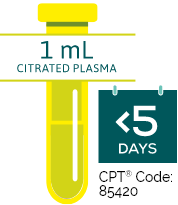
Graphic showing CPT code 85420 for plasminogen activity testing

Plasminogen activity test

Confirm a suspected case of PLGD-1 with a simple blood test for plasminogen activity, CPT® code: 85420, available in many major US labs with results in under 5 days.1-3

Plasminogen activity reference ranges vary by lab; be sure to review results carefully. In adults, the average normal range is 70-130%. Because activity levels don't always reflect symptom severity, patients with levels near the lower limit of normal should still be evaluated closely.2,4,5

View the plasminogen deficiency testing postcard
Nurse icon

Clinical evaluation

Each patient with PLGD-1 can present in a unique manner, with symptoms varying from person to person.

It is vital to run a thorough evaluation, assessing for signs of both internal and external lesions, as PLGD-1 is a systemic disease.3

View the recognizing ligneous conjunctivitis flyer
Family history icon

Family medical history

Since PLGD-1 is an autosomal recessive disorder,* testing patients' family members, particularly siblings, can help identify undiagnosed cases. Symptoms may vary widely even among members of the same family.​3

*Gene sequencing can also be used to confirm PLGD-1 diagnosis.

Warning icon

Untreated lesions can have serious consequences4:

  • Blindness
  • Tooth loss
  • Compromised organ function
  • Infertility
  • Reduced quality of life
  • Life-threatening airway complications
  • Periodontal destruction
  • Organ system failure
  • Hearing loss

It is vital to coordinate care with a hematologist for a comprehensive evaluation and treatment of internal lesions3


Find a hematologist near you

Supporting a PLGD-1 diagnosis

Plasminogen level test icon

Antigen test

Indicating decreased levels of plasminogen can support a PLGD-1 diagnosis, but cannot confirm it on its own1

Fibrinous deposits icon

Lesion biopsy*

Showing fibrin-rich deposits in the biopsied tissue can support a PLGD-1 diagnosis, but cannot confirm it on its own1,6

*Lesion removal prior to diagnosis is not recommended3

Plasminogen gene mutation icon

Genetic testing

Revealing a mutation in the gene coding for plasminogen can confirm a PLGD-1 diagnosis and screen asymptomatic family members, but is not required to diagnose7

An activity test is typically needed to ensure treatment coverage

Plasminogen deficiency testing postcard

Plasminogen deficiency testing postcard

Initial diagnosis of PLGD-1 can occur at any age6,8,9

Median age of diagnosis

9.5months

Diagnosed as late as

61years old

Affects an estimated

1.6per million people

Diagnosed in more females than males

1.6:1female:male

PLGD-1 is rare with highly variable symptoms that resemble more common conditions and can fluctuate over time, leading to missed or delayed diagnoses.3 An estimated 1.6 per million people are affected by PLGD-1.6 While it is an autosomal recessive disorder, PLGD-1 is diagnosed more frequently in females than males for reasons not yet understood.10


While PLGD-1 is a genetic disease, genetic testing is not required for diagnosis.1

Treating PLGD-1

Learn about the latest treatment options and specialists involved in managing PLGD-1.

References: 1. Mehta R, Shapiro AD. Plasminogen deficiency. Haemophilia. 2008;14(6):1261-1268. 2. Plasminogen activity. Machaon Diagnostics. Accessed December 4, 2025. https://‌www.‌machaondiagnostics.‌com/‌test/‌plasminogenactivity 3. Shapiro AD, Nakar C. How I treat type 1 plasminogen deficiency. Blood. 2025;145(25):2954-2965. 4. Shapiro AD, Menegatti M, Palla R, et al. An international registry of patients with plasminogen deficiency (HISTORY). Haematologica. 2020;105(3):554-561. 5. Plasminogen activity. Quest Diagnostics. Accessed December 4, 2025. https://‌testdirectory.‌questdiagnostics.‌com/‌test/‌test-detail/‌4458/‌plasminogen-activity?‌cc=MASTER 6. Schuster V, Seregard S. Ligneous conjunctivitis. Surv Ophthalmol. 2003;48(4):369-388. 7. Congenital type 1 plasminogen deficiency. NORD. Updated February 6, 2025. Accessed December 4, 2025. https://rarediseases.org/rare-diseases/congenital-plasminogen-deficiency 8. Schuster V, Hügle B, Tefs K. Plasminogen deficiency. J Thromb Haemost. 2007;5(12):2315-2322. 9. Klammt J, Kobelt L, Aktas D, et al. Identification of three novel plasminogen (PLG) gene mutations in a series of 23 patients with low PLG activity. Thromb Haemost. 2011;105(3):454-460. 10. Tefs K, Gueorguieva M, Klammt J, et al. Molecular and clinical spectrum of type I plasminogen deficiency: a series of 50 patients. Blood. 2006;108(9):3021-3026.